Chapter 5
AI
Pablo Picasso buys Jarry's Pataphysical Pistol
The History of Pataphysics and how Picasso Explains the Meaning of his Modernist Art
Pablo Picasso studied Pataphysics, as did the Beatles (McCartney), James Joyce, and Artaud. And each of these introduced important new styles, with a new twist on identity and cultural perspectives - related, but each in their own particular field of art.
Pataphysics was a major influence on Modernist arts and literature across the Twentieth Century. It was popularized around the turn of the century by polyglot French author, celebrated (and often-condemned) playwright and philosopher Alfred Jarry (1873-1907).
Among the other serious students of Pataphysics was Marcel Duchamp, the godfather of Dada and Surrealism; iconic composer John Cage; cultural-theorists Foucault and Baudrillard; the key Structuralist, Claude Lévi-Strauss, and a crowd of other such influential artists, writers and academics.
Jarry assiduously succeeded in offending the mainstream; and there are still incomprehensible mainstream critics belittling Jarry, and telling people that he and his influential Pataphysics were nothing but a big joke.
Jarry kept up with the latest developments in math and sciences; and was a notorious roué. He packed his writings with historical, literary, and scientific references; and often brandished a loaded Browning revolver about, to maintain his reputation as a nefarious intellectual. This stuff of course very much excited the rogue intelligentsia. And (following the Avant Garde's disruptive motto) it also properly shocked the housebroken local burghers (épater les bourgeoisie4). Jarry was proudly a definitive poète maudit.5
Pablo Picasso eventually acquired the famous pistol, after it was first confiscated at a haute avant-garde dinner party in Paris, by Apollinaire (the poet who coined the word Surrealism). This because Jarry had taken a pot-shot at an artist guest. Later, Picasso would burnish his own iconoclastic credentials; celebrating at fancy parties by shooting off Jarry's confiscated gun. And he would also pull out the Browning and ominously threaten to débrain stupid viewers who might dare to insult and depreciate his ablated pataphysical paintings, by rudely asking him "What do they mean?"
And Picasso was known for pulling out Jarry's pistol to admonish anyone he might catch carelessly speaking badly of Cézanne, the artist who according to Picasso, was "The father of us all". (Due to Cézanne's pioneering work with geometric redaction, ablation, and structurality). Cézanne has very rightly been called the Massaccio of Modernism. He provided the fundamental math and geometrics paradigm, from which the whole Modernist school of art and philosophy derives. (Same service as provided for the Renaissance by Massaccio with his transformative Single-Point-Perspective in 1427). In the history of philosophy: the theory and practice of Deconstruction (Structuralism) began with Cézanne and his absolute violations of Massaccio's (and Alberti's) Renaissancy single-point geometries, and their consequent prespectives.

André Breton defined Surrealism, wrote the Manifesto of Surrealism in 1924, and is generally recognized as Surrealism's most important writer. Breton said Jarry was “the master of us all”.
Beatle songwriter Paul McCartney studied pataphysics and was inspired to write a pataphysics parable: the paradigmatic song Maxwell’s Silver Hammer, on the Beatles revolutionary Abbey Road album. He wrote it essentially as allegorical pataphysics liturgy.
"Joan was quizzical; Studied pataphysical; Science In the home"... 7
Early pataphysicians used the term “dé-braining” to describe how a person overcomes their old dysfunctional habits of conceptualization, and begins to understand their thoughts and communications with a new mind; in a new way. McCartney modeled his unusual song after a French pataphysics anthem, simply titled: Chanson Décervelage (Débraining Song). McCartney's verses allegorically describe Edison, a pataphysics intern, administering débraining therapy (décervelage ) to a friend, a policeman and then a judge. With his little silver brain hammer.
Maxwell's Silver Hammer is a blatant allegorical report, coded in pataphysics vernacular, boasting of how the Beatles and others were radically Revolutionizing (débraining) the new psychedelic post-war youth culture (John Lennon said "more popular than Jesus").
Opinions that didact Jarry would sometimes use his pistol specifically to threaten décervelage, for people who were slow to understand pataphysics, have not been confirmed. Though, as mentioned above, it is documented that Picasso later used that Browning revolver for a very similar purpose.
Alfred Jarry's Gun of course is the one singular object in the world with the best chance of successfully débraining a seemingly-hopeless bumpkin, who would question the meaning of Picasso's mind-bending, faux-primitive, pataphysical memes on canvas. Picasso must have enjoyed that poetic synchronicity. There are still a lot of people in the world who don't see any reason for Picasso's work, and just don't get why Modernism.
(For extensive scholarly documentation of Pataphysics, with its cultural influences and histories, see the excellent Pataphysics - A Useless Guide, Hugill 2015, MIT University Press.)
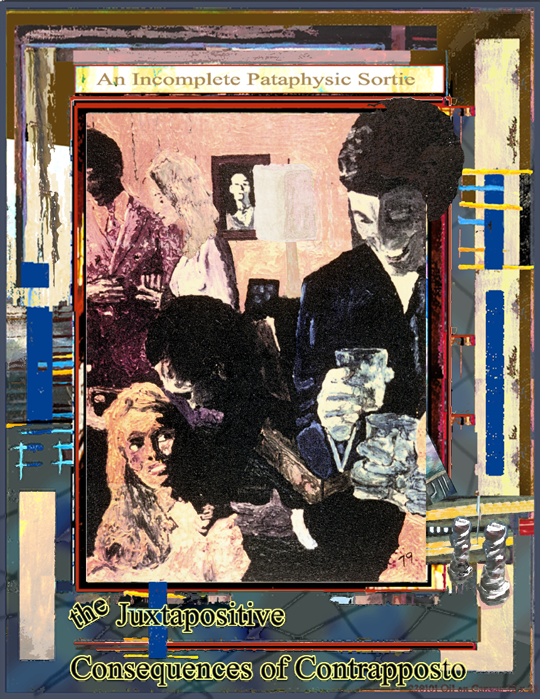
Pataphysics is a Modernist (and strangely, also postmodern) deracinated way of understanding semiotics, especially very-low-bandwith symbolism (such as Structuralism's "generic signifiers"), with intersectional allegories and allergies. And of decoding, detourning, manipulating and repurposing referential or metaphoric communications, and various artistic and literary epistemologies.
Picasso memorized occasional passages from Jarry’s plays, collected some of Jarry's original writings, and painted portraits of Jarry. Picasso's gamechanging Demoiselles d’Avignon8 has been called the Finnegans Wake9 of modern painting. These works both feature a paradigm shift in the direction of pataphysics and its unusual dimensional metaphorics. Both works abandoned long cultural traditions and histories of careful isomorphic description; per Picasso in painting and Joyce in literature. Then (as noticed by Clement Greenberg's Grand-Unification-Theory of Modernism) both artists began focusing mostly on just understanding the fundamental parameters of how their own medium itself communicates metaphors and other referentials, (painting and sculpture for Picasso, and language for Joyce.)
Modern-ism, as defined so precisely and well by Greenberg, is a detailed semiotic paradigm; and not at all the same thing as merely "modern" art. Finnegan and Demoiselles both feigned allegiance to traditions of descriptive narrative scene painting and storytelling respectively. But they were both using the traditional means and methods to convey a very different kind of information. And they were both wildly successful at it - despite so many naive accusations of nonsense.
Aside from who-and-what-influenced-whom, and how: Johnson calls Picasso the primary PosterBoy for Pataphysics - in terms of impressing on world culture what pataphysically-abstracted metaphors and allegories can accomplish in a new completely unique genre of art. Picasso changed everything; and everybody recognized that. And in 1939, with his world-acclaimed Finnegan, James Joyce became PosterBoy for Pataphysics number two, with his reducting of an entire traditional narrative into an abstraction of orphaned nouns, with non-targeted metaphors and allegories - at times adopting an almost hieroglyphic focus on raw grammar and syntax, instead of on the customary face-value meaning of words. With respect to the face-value meanings of words - Joyce is an ablating demon at the cutting room floor.
Finnegan's Wake and Demoiselles - these works were still categorically similar to traditional painting and literature; but the kind of information being communicated is obviously unusual and extenuated. Two groundbreaking landmarks for the Great Modernist Débraining of western perspective, philosophies, arts and literatures, communication, and culture.
According to the explanations of critic Clement Greenberg, (grand poobah, New Yok Times' art czar, and high-priest of Modernist art theory): Picasso’s painting was reflexive, self-signifying, Modernist, work about the means and methods of painting itself - not about streetwalkers, guitars and candlesticks. And Joyce’s work was about the means and methods of linguistically communicating culture - not about telling a story, or reciting some particular narrative, or novel.
The standard example here, according to Johnson, is how Picasso and Braque were studying the primary conceptions and most-primitive painterly tools by which an artist can actually address the moment where painterly art begins. That is, the moment where meaningless abstract markings begin to turn the corner; changing into metaphors, allegories, and visual memes with referential (semiotic) meanings. And among the specific discoveries catalogued by Picasso and Braque was that it would take just one black disk, in the vicinity of one double-humped curved line, and three or four straight parallel line segments to sufficiently reference the idea of "guitar". Picasso and Braque re-demonstrated permutations of that particular pataphysical result over and over again, across the years of doing their revolutionary guitar-reference paintings.
The New York Times art critiques had high praise for Greenberg's explanations of how this new Modernist genre of art is a singular separation from the previous history of art; all the way back to the very beginning. On the other hand, a common theme in the pedestrian public's response to work such as Demoiselles and Finnegan was along the lines that any idiot with half a brain could do better work. Johnson's opinion is that all of this influential work demonstrates a perfect conflation of Greenberg's Modernist "means and methods" theory with a properly-isomorphic semiotic débraining of the artists and their viewers.
Clement Greenberg's apotheosis was basically due to his clear and erudite propounding that Modernist artists are "artist's artists". They are researchers, investigating the "means and methods" of communication, rather than storytellers and producers of decoration. Their work is meant not so much for the public (as in previous times) - their work is self-referential, and is meant to be appreciated mostly by other artists, and the art community ("Tout le Monde" per Tom Wolfe). Critic Greenberg's aphoristic and elegant explanation, now known as Greenberg's Haiku, says it all in three lines:
The best Modernist sculptors are sculptor's sculptors;
The best Modernist painters are painter's painters;
The best poets, poet's poets.
In 1975 Tom Wolfe’s little book, The Painted Word, quickly became a must-read for artists and art critics – explaining how the new Modernist arts had been co-opted by art theorists. Painting, Wolfe explained, had become a completely new enterprise, no longer about telling stories, or decorating homes and public spaces. Modernist painting is about what the theorists and critics write about what the practice of painting should be. Wolfe wrote that Modernist painting was just the handmaiden of those who write about the practice and goals of art.
The way Johnson tells the story, this all began when artists like Picasso and Duchamp promulgated their new impossible-to-know-what-it-means genre of art. Then the engaged, curious viewers begin asking Picasso to explain the meaning of his unusual Modernist paintings. So Picasso threatens to débrain them with Jarry's gun and, like a few others, completely refuses to give any sensible explanations. Then Apollinaire or Breton, or somebody like that writes down a theory to explain why Picasso seems so obstinate about meaning, why his painting is cubistic like Cézanne's; and why his iconography and semiotics seem so prehistoric; or whatever. And then - insecure and uncertain artists began to study the critics' theories before they would paint - so their work would be part of the new movement. Greenberg and Wolfe both point out that this trend is an amazing cultural change of tide. And like Massaccio's new-fangled geometric single-point-perspective paradigm in the pre-Renaissance, it extends far beyond the palings of art itself.
Jackson Pollock, is a prime example of how all this worked. Sometimes, before painting, he would meet and collaborate with Greenberg on how to make purely and true non-referential art. The final goal was to solve their problem by completely getting rid of all semiotics, metaphors, allegories, and referentials of any kind. Modernist painting should be genuine, non-referential, non-metaphoric, non-allegoric art. Art which would be only about the flat canvas itself, the splashy self-nature of paint as it is flung and dripped onto canvas, and how the inner private characteristics of the artist are automatically “Expressioned” in the energies of splashing, as the paint attaches itself to the canvas. Art became non-referential, anti-metaphoric, self-signifying, and reflexive.
Groundbreaking communications theorist Marshall McLuhan generalized on a related thread with his famous pronouncement: the "Medium is the Message", (or at least it's often the most important part of what gets communicated). In other words, in perfect accord with Jarry and Greenberg, the "medium" (means and methods) of a writing, painting, or other communication often communicates more of the intended message than the face-value meaning. And Johnson has suggested that, given his acclaimed demonstration of the "Kikki-Bouba effect", psychophysicist and professor of neural metaphorics and behavioral neurology, V. S. Ramachandran could likely be convinced to explain how such praxes and practices are second-degree metaphoric, or better yet, instances of synesthesic onomatopoia.11
Johnson opines that whether or not Jarry's pataphysics can be traced as the major driving force behind Modernism, it's impossible to overstate how much world culture changed as it accepted these new semiotically-irrational, ablative, Modernist genres in the various arts.
James Joyce, Irish drinker and wordsmith, was known as a pataphysics alcolyte. Readers, professors, academic poseurs, criterati, and the glitterati, through the years, have studied Joyce's unusual intentions and innovative conceptualization - which for example are so obvious in his famous minimally-contextualized, and specifically non-fungible, yet ever-quoted line from Finnegans Wake "Three Quarks for Muster Mark".
As mentioned previously, Johnson says that one can easily understand what Joyce is doing in many parts of Finnegan just by deconstructing them into Joyce’s Structuralist pataphysical memes. For example, he says the face-value meaning is obviously indeterminate in the phrase “three quarks for Muster Mark”. "Three" and "for" are the only words here with identifyable primary meaning.
"Three Quarks" (This is just a piece of ablative structural syntax.)
Three has a meaning here, but Quark does not. So maybe I, or somebody else, wants, needs, or has, three quarks. Or it could mean just that there were, or there might be, three quarks. It could be part of a reference to how it takes three quarks of fuel to get your vehicle to its destination. The only meaning here is Structural.
"for Muster Mark" (This is also just a piece of ablative structural syntax.)
For whatever reason, these three unidentified quarks are to benefit - or to go to - or be added to - or be delivered to - or were somehow required by - Muster Mark – whatever - or whoever - or whomever; that might be. Perhaps Mark is the name of an officer with the position of "Muster". Or perhaps Muster Mark is a holiday ritual that requires three quarks to be recited, or maybe to be sacrificed. Muster Mark could be the name of a local god, somewhere. Or the name of the pond or forest your vehicle can get to if you had three quarks of fuel. And the only meaning here is an ablated syntax or blank Structure.
Once deconstructed this way, it’s easy to see that unless Jarry is responsible for all this, Joyce has invented the main theory of Structuralism, decades early. Joyce has completely stripped away all direct semiotics, and all face-value meaning, thus dissolving any possible narrative purpose. He leaves only the Structure, the anchorless allegory; the syntax; the means and methods, of his craft. In perfect accord with Jarry's pataphysics, as well as the details of Greenberg’s Theory of Modernism.
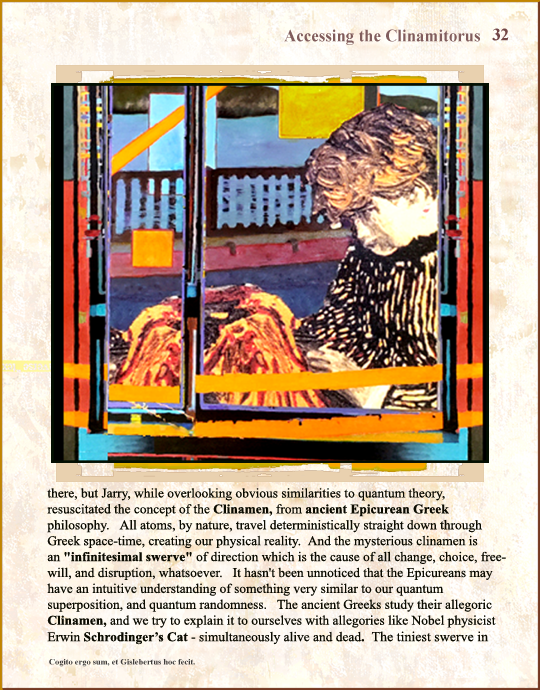
Jarry, while overlooking obvious similarities to quantum theory, resuscitated the concept of the Clinamen, from ancient Epicurean Greek philosophy. All atoms, by nature, travel deterministically straight down through Greek space-time, to create our reality. And the mysterious clinamen is an "infinitesimal swerve" of direction which is the cause of all change, choice, free-will, and disruption, whatsoever. Pataphysics literature and commentary has often referenced the clinamen and made various metaphoric references to its infinitesimal swerve. It hasn't been unnoticed that the Epicureans may have an intuitive understanding of something very similar to our quantum superposition, and quantum randomness. And where the Greeks refer to their clinamenic allegory, we try to explain it to ourselves with an allegory about Nobel physicist Erwin Schrodinger’s Cat.
More than one article has been written about clinamen's influence on Joyce’s writing. How, for example, the difference between Finnegan and all regular novels is just the casual, but stunning, way Joyce weaves the tiniest of "clinamenic swerves" into his ablated narrative(s). Duchamp used a term from French calculus class to describe it: "infra-mince" ("delta-h" in English) i.e. infinitesimally small. Duchamp explicitly describes "a gap, thinner than thin". "The warmth left on a chair after someone stands up." "The smell of cigarette smoke mingling with the smoker’s breath."
A lot of Modernism's most important movers and shakers have praised pataphysics or acknowledged Jarry and pataphysics in writing. Maybe Jarry was a main instigator of the ideas behind all this, or maybe not. Maybe Jarry was just a collector and disseminator of ideas which percolated through the fin-de-siècle French avant garde. But in any case, he was at least a very significant figurehead, nexus, or posterboy for the movement and the ideas behind it.
The influence of pataphysics is well-known regarding the works of Picasso, Duchamp, and Joyce. Other notable influencees include Miro, Tinguely, Apollinaire, Borges, Calvino, Ionesco, Jacques Lacan,
Baudrillard,
and Julian Barnes. Also renowned tres-moderne composer
John Cage,
who famously noted that Pataphysics "influenced everybody".
Pataphysics as a movement might be narrowly described as a very influential, century-long, set of unexpected Modernist and postmodern literary and artistic works which are especially focused on fungible referentials - words and various other passages of metaphoric and allegorical representation. This includes Beaudrillard-type intangible conceptuals facilitated by his symbolics, structuralities, and ambulatory tropes. To quote McLuhan, the Medium is the Message here, and it's the tertiary too.
The prolific and much-studied pataphysician
John Cage,
was an experimenter, and a theorist of music and sound itself. And he composed such avant-garde compositions as a Symphony for Percussionist with thirteen found objects, and a symphony of
Random Radio Sounds.
It's been noted that pataphysics is demonstrated in how some of these works refer secondarily to all the traditional modes of human music, and the means and methods of making of it.
Overlooking his own accomplishments and those of Picasso, Duchamp and many others, Cage asserted that James Joyce, with his extremely creative and unconventional writing, makes better use of Jarry's pataphysics than any of the other creative luminaries within Jarry's wide circumference of influence.
F. T. Marinetti (author of The Futurist Manifesto and founder of the Futurist movement) called Jarry “the unquestionable literary genius of the underworld.”
One of Pataphysics' integral angles is illustrated in its denying the accuracy of all categories in general. Categories are inherently fuzzy and inexact. Patagories on the other hand, are precise and perfectly defined; but each patagory is therefore so tight that it patagorizes only one unique thing, in a collection of only itself. Jarry at least pretended to search for this semiotic perfection, before concluding the concept to be a mirage. He claimed to be hoping that each thing could be perceived, referred to, and understood in its own perfect uniqueness. But then he recognized the nasty paradox at the heart of Structuralism, which arrived half a century later: that even though things are unique and exceptional in themselves, we can only understand them in the context of Structured Categories that we're already familiar with. V. S. Ramachandran likes to tell his students that the "human brain is a pattern-recognition engine."
Jarry said pataphysics is about grasping the law that governs exceptions. All the unique things which are not properly categorizable. That is paradoxically: the law that governs all things which are exceptional, and thus not subject to such law. (Nor by definition to any other other law of categoric governing.)
The Collège de 'Pataphysique later explained the beautifully double-symmetric obverse to Jarry's paradoxical law: “there are only exceptions in the world, and a law is just the "exception to an exception.” A law which is thus perfectly reflexive and negatory, at the same time.

Pataphysician and professor Andrew Hugill famously said “to understand pataphysics is failing to understand pataphysics”. What Hugill means by this, according to Johnson, is just that everything is properly understood as unique, and “exceptional” - and therefore one cannot really understand any thing by understanding some other thing - either categorically or categorically. Pataphysics is about remembering that dilemma, and keeping it in mind. According to Johnson, that's the prime cotangent of Pataphysics. Wanting or expecting precision clarity in conceptualizing or communicating categorically is a fool's errand. When it's examined the concept is absurd. Or as Structuralism points out: impossible to fathom without distorting the communication to fit some familiar pre-existing conceptual structure. Ancient Greeks invented the famous and much-referenced Procrustes Bed allegory (myth) to poetically model this same Structuralist paradigm.
Ordinary hidebound rational thinking often can’t get beyond this apparent difficulty with paradoxes. Antonin Artaud, on the other hand, along with several other avant garde artists, understood (as Zeno did) the usefulness of conceptualizing absurdity and the paradoxical. He was an important precursor to Theater of the Absurd. When he opened a physical venue for this radically different kind of theater he named it Theatre Alfred Jarry.
Regardless of its value in redefining the direction of Modern painting, Demoiselles, and Picasso's other work of that genre, like Finnegan, is absurd (traditionally). Picasso, Johnson says, thought it was a perfect lesson he was teaching occasional lunkhead viewers by pulling out Jarry’s gun and threatening to shoot/débrain them with it – when they would absurdly dare to ask him about the “meaning" of a Modernist painting.
Marcel Duchamp,
patriarch of Dada and Surrealism, postmodern painter, avant-garde performance artist, and instigator of absurd “readymade” (store-bought) sculpture, implied that the influence of Jarry's pataphysics was plainly evident in his own writings and art. He proclaimed that “Rabelais and Jarry are my gods - evidently.”
'Pataphysics is about the pragmatics of “meaning” per se. It’s about half-addressed allegories, augmenting adjectives, generic signifiers,
and deliberate focus on the exaggerated advantages of understanding that all words, sentences, and other symbolic or referential communication can,
at best, be only fuzzy representations. They can never amount to more than some significant degree of allegory or metaphor. All referentials
are only representations, and all representations are just some credible variety of generic signifier.
In at least reflective accord with Heisenberg's Uncertainty Principle, Gödel's Incompleteness Theorem, Postmodernism’s incomplete succotashes, and the tenor of
Collège de ’Pataphysique, in Paris:
pataphysical documents may have no formal beginnings or endings, elliptical or second degree logic, and meanings often transmitted mostly or only in overtones, structuralities, or subtexts; rather than the face-value or semiotic message of the thing.
or subtexts - and per Jarry’s Dictum: reader/user input is often required of the 'Pataphysics practitioner to imagine more precise definitions for superpositional, or otherwise inherently inexplicit nominatives, vocabulary, structurality, and syntax.
As Structuralism explains, all users of language (or other semiotics) constantly encounter these semi-abstract generic signifiers; and they are thus engaged (usually without knowing it) in at least some significant degree of practical pataphysics; although as Johnson explains they often never find a
8 ...or even Jarry’s pataphysics and the intuitions of artistic integrity. But aside from that, many of these are representations of ordinary people, inside of those previously-mentioned, highly-structured, multi-dimensional, spaces or suites. Given their contemporary situation, that’s an obvious and precise analogy. They’re visual metaphors and similes to the modern human condition: Half-conscious sapient avatars, and mutant Homo Erectus ground-apes, now living inside very large and complicated communal nestings of diverse structure and different dimensions of conceptuality. And it’s barely two million years since Homo Habilis first sharpened a flintstone. Regardless, it seems clear that one would have never expected this kind of
Screen width will be displayed here.