Pataphy.com (mobile/small version). Most of the texts will be too small to read on a small device, so the texts have been copied out and then appended after each page. A larger screen should give a better viewing experience.
In accord with Heisenberg, Gödel, Postmodernism’s “Incompleteness”, and the tenor of Collège de ’Pataphysique in Paris: pataphysical documents may have no formal beginnings or endings, second degree logic, meanings often transmitted only in overtones or subtexts - and per Jarry’s Dictum, reader/user input is often required to imagine more precise definitions for superpositional, or otherwise inherently inexplicit, vocabulary and syntax.
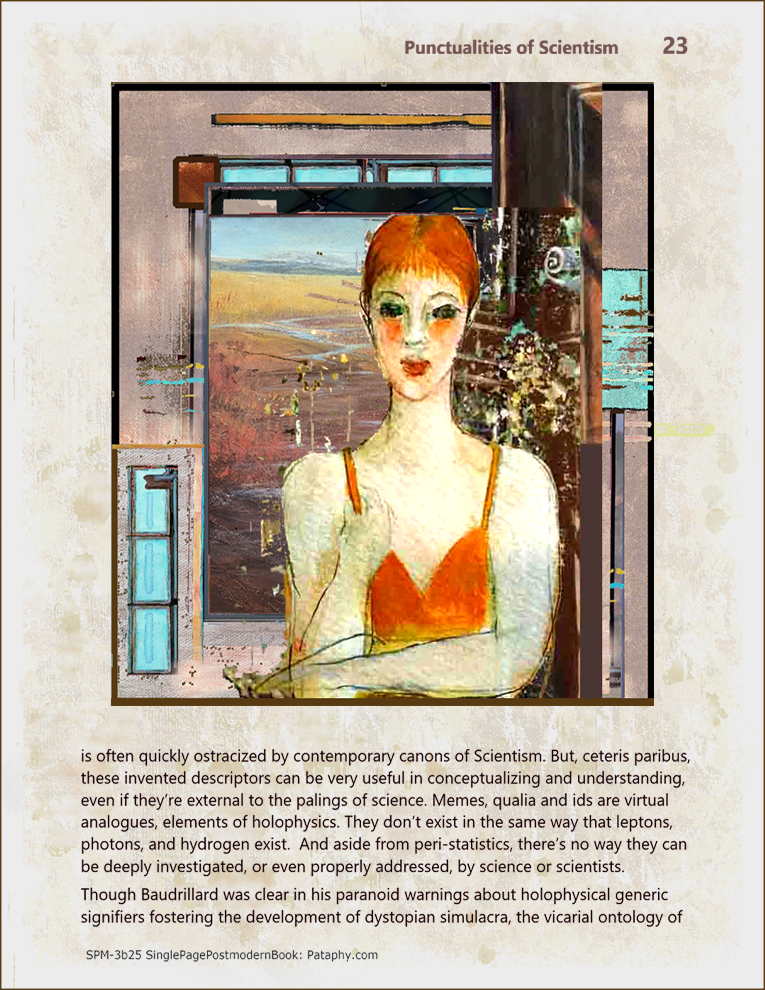
is often quickly ostracized by contemporary canons of Scientism. But, ceteris paribus, these invented descriptors can be very useful in conceptualizing and understanding, even if they’re external to the palings of science. Memes, qualia and ids are virtual analogues, elements of holophysics. They don’t exist in the same way that leptons, photons, and hydrogen exist. And aside from peri-statistics, there’s no way they can be deeply investigated, or even properly addressed, by science or scientists.
Though Baudrillard was clear in his paranoid warnings about holophysical generic signifiers fostering the development of dystopian simulacra, the vicarial ontology of
or that Wells Fargo agents had cheated him out of a mine he owned several years prior to that. So with a shotgun, and a flour sack with eye holes pulled over his head, he became the infamous California highwayman-poet, specializing exclusively in Wells Fargo stagecoaches and their strongboxes. In August of 1877, at a successful holdup near Duncan Mills, he left his famous explanatory poem for the Wells Fargo bankers, which he signed, calling himself Black Bart: “I’ve labored long and hard for bread; for honor and for riches. …Too long you’ve tread upon my corns; you fine-haired sons of bitches.”
Bowles’ contemporary, Charles Peirce (remembered as the father of Pragmatism) was a fellow of the erudite William James crowd at Harvard. He invented and named the modern science of Semiotics: the study of signs, and signals, and referential meanings. As part of that effort Peirce coined the cognitive psychology term quale in 1866 (from the Latin root for qual-ity.)
Johnson, however, doesn’t really describe or explain her own meaning. It’s tenuously engaging, but vacantly non-descript in that regard. It was that consideration of Picasso’s Demoiselles d’Avignon as a perspectival Rorschach test that got her to start thinking about her bandied didactic conundrum regarding whether non-descript (or non-referential) meaning per-se is more of a meme or more of an ablated quale.
Peirce’s quales, or more properly qualia, are the most basic sentiences or experiences possible, Johnson says: like red, hard, cold, difficult, and salty, etc. Neuro-psychologists have called qualia the alphabet of consciousness. They’re the leptons of awareness, the smallest single chunk of sentient-awareness one can detect. The awareness of red per-se is a quale. Conscious awareness of the quale red is integral to all possible ways of consciously experiencing or conceiving redness.
else, or his example for the parsing of memes and qualia. Consider the phrase: is often quickly ostracized by contemporary canons of Scientism. Johnson’s analysis starts with the word often - it’s a quale; a solitary single quality, which has no component parts. It’s a binary quale: i.e. a given amenable event, in a given set of circumstances, is either often or else it’s not-often. The idea or concept of “often” is leptonic; it’s a quale - indivisible. It’s a letter of the most basic kind in the alphabet of conceptualization. Each of the other words (i>quickly, ostracized, and by, etc.) is also a quale. But all combinations such as quickly ostracized, or contemporary canons, etc. are memes; meaningful multipartite clusters of qualia. The mind of genus homo will, if
Evolutionary biologist Richard Dawkins coined the popular word meme in 1976. It essentially refers to a packaged unit of meaning which can be transmitted from person to person. To continue the particle-physics metaphor: qualia are the indivisible smallest particular chunks of conscious awareness; and memes are the complex molecules of meanings which are ultimately composed of clustered quales.
The Renaissance inherited strong linear thinking, syllogistic logic, contrapposto, and single-point mathematical perspective from long previous Classical times. Picasso blew that all away in Demoiselles. There is no trace of contrapposto, or any of the Greeks’ linearly isomorphic direct mapping whatsoever between Picasso’s referential work and the group of ladies it represents. That painting is a second-degree permissive metaphor.
Expanding on the vicarial ontology of qualia, Johnson explains how they're fundamentally metaphoric in nature, allowing consciousness to reference the external world; and how it’s not theoretically possible for the subject of a metaphor, a word, or any other kind of referential symbol to ever conflate in a perfect linear way with its own object.
Never a perfect match; and sometimes (particularly in postmodern art and literature) a relationship between the subject and object of a metaphor or other symbol may be so obscure as to not be initially obvious at all. Or it might even be designed with random qualia, or a permanent vacancy in part, or even all, of the meaning.
Pataphysics is about half-addressed allegories, augmenting adjectives, generic signifiers, and deliberately focusing on exaggerated advantages in the fact that all words, metaphors, and other symbolic or referential communication can, at best, be only fuzzy representations. They can never amount to more than some significant flavor or degree of allegory or metaphor, which will remain in an unresolved elaboration of not only the underlying structuralist perspectivals, but
earthshaking like Ramanujan’s mathematical insights were - and it feels somewhat important. People don’t take much conscious notice of this instinctual experience, she says - due to the left-brain’s dictatorial linear insistence on having names, categories, and plenary verbal descriptions for anything which is to be consciously contemplated.
Studies now show that a significant percentage of modern populations are overly-verbalized people who do confuse meaning per-se with fallow tranches of verbal description, and who have trouble conceptualizing fuzzy, inexplicable, or nameless
or at any rate, raw consciousness, or pure awareness per se is not the same thing as thinking. She says one popular theory about mind argues that the process we recognize as “thought” is completely dependent on the words and linguistic structures we use, the meanings they represent, and what concepts those linguistics allow us to compose.
Psychologist Julian Jaynes’ seminal book on bicameralism, modern self-recognition, and self-identity documents how in Iliadic times, three millennia ago, the Greeks’ thinking processes were externally focused, and people did not have the modern sense of inner, conscious self-reflection that we now associate with the "mind".
When mental evolution suddenly created a need for more sophisticated self-referential concepts, the Greeks detourned or repurposed traditional words referring to the body and its functions, creating new words to express new kinds of inner-reflective concepts about mind and self-consciousness.
For example, the Greeks took the word pneu, meaning “breath,” (per our pneumatics and pneumonia); and modified it with a new intangible meaning. Their newly-invented word or conceptualization of pneuma refers to their new idea of a “spirit” – a concept Jaynes explains as unavailable to pre-Iliadic Greek thinking; and absent in pre-Iliadic writing.
In the mid 1800s Harvard’s William James, the noted father of modern psychology, instigated a need for modern people to have new words, such as quale, and meme, in order for the newly-observant empirical culture to conceptualize the basic mental realities of conceptualization itself. And once
… acta non verba - cogito ergo sum …
In Lorem Ipsum Veritas
Investments in the Personal Isomorphism
and the reclamation of solipsism as a strategy.
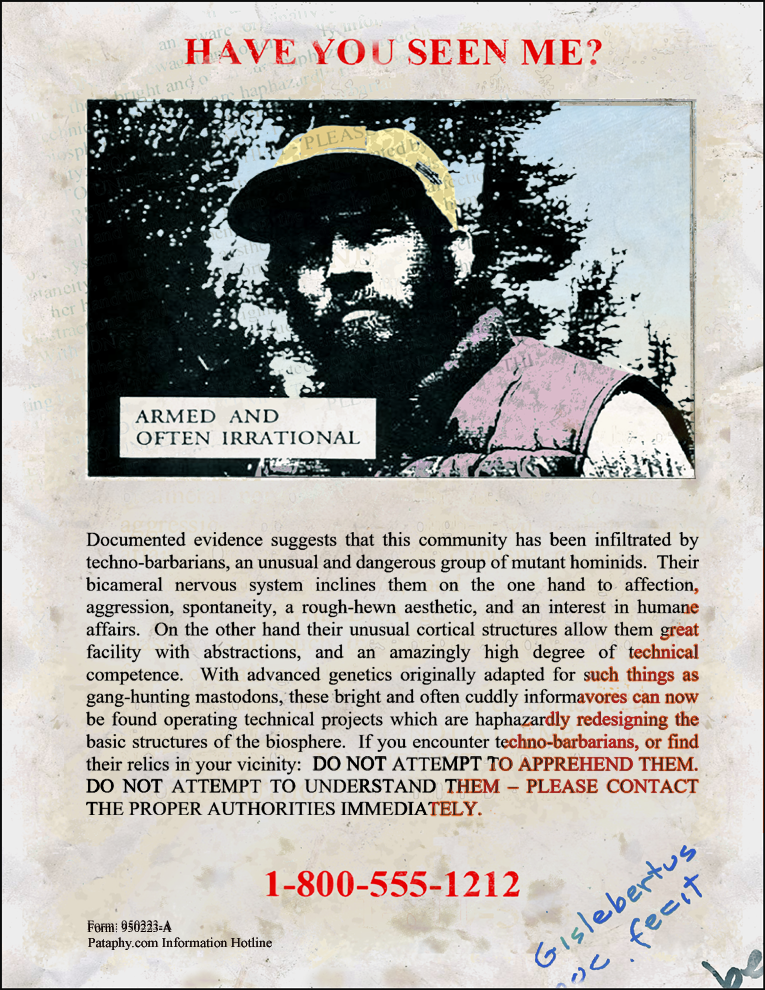
Have You Seen Me?
Documented evidence suggests that this community has been infiltrated by techno-barbarians, an unusual and dangerous group of mutant hominids. Their bicameral nervous system inclines them on the one hand to affection, aggression, spontaneity, a rough-hewn aesthetic, and an interest in humane affairs.
On the other hand their unusual cortical structures allow them great facility with abstractions, and an amazingly high degree of technical competence. With advanced genetics originally adapted for such things as gang-hunting mastodons, these bright and often cuddly informavores can now be found operating technical projects which are haphazardly redesigning the basic structures of the biosphere.
If you encounter techno-barbarians, or find their relics in your vicinity: DO NOT ATTEMPT TO APPREHEND THEM. DO NOT ATTEMPT TO UNDERSTAND THEM – PLEASE CONTACT THE PROPER AUTHORITIES IMMEDIATELY.
1-800-555-1212